


22 June, 2026
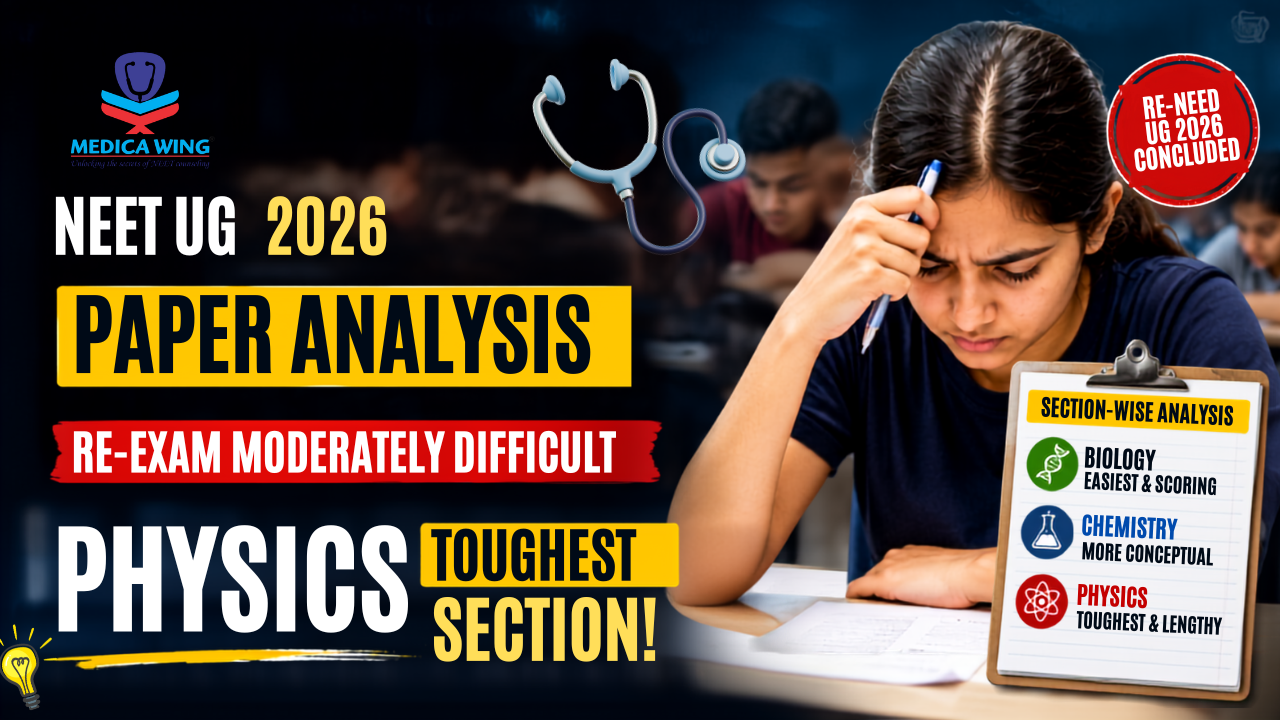
NEET UG 2026 Re-Exam Analysis: Physics Emerges as Toughest Section, Biology Remains Scoring
Overall Difficulty Level
According to feedback received from candidates and educators, the re-exam presented a balanced yet demanding test of knowledge. Students who maintained a strong grasp of NCERT concepts and practiced regularly were better positioned to handle the paper effectively.
Many candidates felt that the June examination required greater analytical thinking compared to the original session, particularly in the science subjects.
Biology Continues to Be Student-Friendly
Biology was widely considered the easiest and most scoring section of the exam. Most questions were based directly on NCERT topics, with significant emphasis on Genetics, Human Physiology, Reproduction, and Ecology.
Students reported that the section was straightforward and could be completed quickly, allowing them to allocate additional time to more challenging subjects. However, a few questions in Zoology reportedly generated discussion among candidates due to perceived ambiguity in answer choices.
Chemistry Demanded Better Conceptual Understanding
Chemistry was viewed as slightly tougher than in the May examination. Physical Chemistry included lengthy numerical problems that required multiple calculation steps, making time management important.
Organic Chemistry focused more on understanding reaction mechanisms and concepts rather than simple memorization. Students who relied on conceptual clarity performed better in this section.
Physics Proves Most Challenging
Physics emerged as the toughest section of the re-exam. Questions were heavily drawn from topics such as Mechanics, Electrodynamics, Thermodynamics, and Modern Physics.
Many candidates found the section lengthy due to its numerical and application-based questions. The calculations involved often required careful analysis, making Physics the most time-consuming part of the paper.
Expert Opinions
Academic experts observed that the paper remained largely within the NCERT framework but rewarded students who possessed strong conceptual foundations.
Education specialists noted that while Biology remained accessible for most candidates, success in Physics and Chemistry depended significantly on analytical reasoning, accuracy, and sustained concentration during the examination.
Expected Cut-Off Trends
Initial predictions suggest that the cutoff marks may vary depending on the final performance distribution of candidates.
Some education analysts believe the re-exam could be slightly tougher than the original May session, potentially leading to a modest reduction in cutoff scores. Estimates indicate that the All India Quota (AIQ) General Category cutoff for government medical seats may fall in the range of approximately 590 to 600 marks.
However, final cutoffs will depend on overall candidate performance and seat availability.
Comparison with the May Examination
The original NEET UG 2026 examination conducted in May was generally rated as moderate. Physics and Chemistry tested conceptual understanding and calculation skills, while Biology remained relatively straightforward.
Compared to that paper, the re-exam appears to have placed greater emphasis on application-based learning and numerical problem-solving, especially in Physics and Chemistry.
Key Takeaway for Aspirants
A common theme across both examinations was the importance of strong NCERT preparation, regular practice, and effective time management. Experts believe that students who focused on understanding concepts rather than relying on last-minute revision strategies were best equipped to perform well in both sessions.
As the admission process moves forward, candidates now await official answer keys, results, and final cutoff announcements.
